Calling all AEU Tasmanian Branch members: nominate now for union elections!
The AEC has opened nominations for the 2026 Tasmanian Branch elections. With 105 roles up for election, there’s a position for your level of experience and commitment. Every union member is already a union leader – so step up and help take our union forward!
Nominations will close at 5pm AEDT, 28 September 2028.
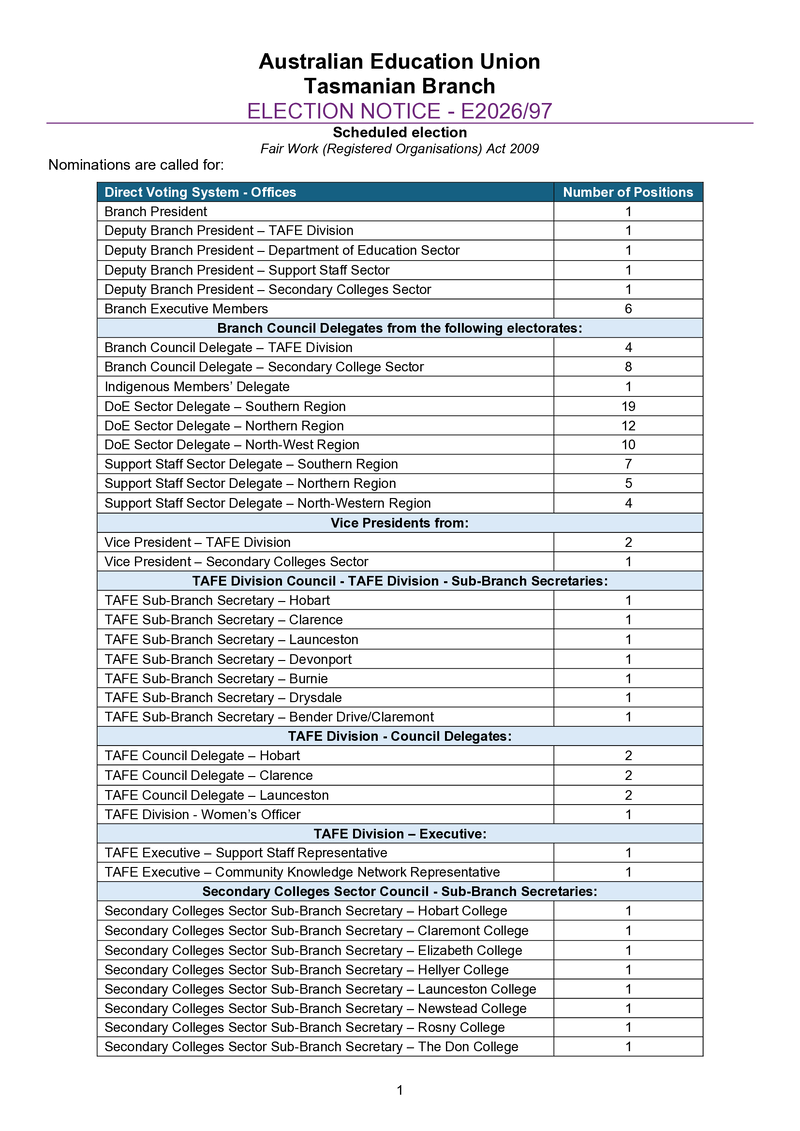
Positions up for election include Branch President, x4 Vice Presidents (TAFE Division, Senior Secondary, Support Staff & DECYP), Branch Council, Executive, TAFE Executive and Secondary Colleges Committee of Management.
Click here to read the AEC’s full election notice.
If a ballot is required, voting will open on 19 October 2026 and close at 10am (AEDT) on 16 November 2026.
How to Nominate:
- Key points:
1. You can nominate via the AEC’s online portal or by emailing IEBnominations@aec.gov.au with the subject line ‘ATDJV – E2026/97 – Nomination [Name of candidate]‘
2. Don’t forget to include a candidate statements and photo! Email attachments must not exceed 6 MB in total size.
Nominations are available below or on the AEC’s website!
Nominations must be submitted either:
By portal: Visit the Australian Electoral Commission Portal at www.aec.gov.au/ieb. From this page, select “Access the electoral event portal,” then click “Current industrial elections.” Locate and select yourelection, then access the nomination documents.
By email: A fully completed nomination form, including all necessary signatures, may be scanned and emailed to IEBnominations@aec.gov.au.
Nomination forms may be submitted as PDF files, with each candidate’s form in a separate PDF. Candidate statements must be provided in Microsoft Word or RTF format, and photos (where applicable) should be submitted in JPG, JPEG, or TIF format.
IMPORTANT INFORMATION ON EMAILS:
Emails that appear to be spam may be blocked. It is the sender’s responsibility to ensure their nominationemail is delivered to the returning officer before the deadline. Emails and attachments must not exceed 6 MB in total size.
Full details and contacts can be found on the AEC’s website.
What’s involved?
Branch Council
AEU Branch Council is the supreme governing authority of the Tasmanian Branch. They have the power to control and manage the business and affairs of the Branch. This includes but is not limited to (see Rule 3):
- Develop policies for the advancement of the industrial and professional interests of members
- Make, amend and rescind Federal Branch Rules
- Allocate and expend monies from the Branch fund and for any purpose required by Federal Branch rules
- Appoint and remove Returning Officer and auditors.
- Determine subscriptions
- Seek, obtain or oppose the making of Awards and Agreements and enter into industrial agreements
Branch Councillors must attend 4 meetings in a calendar year – one per term. If unable to attend, councillors can appoint a proxy by writing to the Executive Assistant before the meeting commences. Sometimes it is possible to attend via video call. Councillors who travel approx. 2 hours to meetings can request accommodation for the night preceding the meeting. Individual car travel can be reimbursed.
Branch Executive
Branch Executive members are elected from the membership as a whole. They are elected for 3 years. All Branch Executive members are required to undertake governance training through ACTU and provide evidence of completed training within the first 6 months of their initial term.
Function and representation on Branch Executive is governed by Rule 7. Rule 7 states that the key function and powers of Executive are:
- Branch Executive are subject to the decisions of the Branch Council and must conform to and abide by Branch Council decisions
- Between Branch Council Meetings, Executive can make policies consistent with those made by Branch Council
- Executive appoint or remove employees including the State Manager and determine terms and conditions of employment
- Executive may exercise some of the powers of Branch Council between meetings. See Rule 7 (3) (b)
Executive members also:
- Manage the Rules Committee
- Join reference groups and report back to Executive
- Lead the Communication Tree Network
- May be called on to speak to media or at rallies
- May be called on to run stop-work or other meetings
Branch Executive meets 8 times per year, approximately 2 meetings per school term. Extraordinary Branch Executive meetings can be called by Branch Executive, the Branch President or the State Manager whenever necessary.
Branch President
Role and Responsibility of Branch President (Rule 23 (1)):
The Branch President is the Chief Executive Officer of the Branch. They are elected for 3 years and cannot be elected for more than 2 consecutive terms. Branch President is a full-time paid position.
Branch President has the following key responsibilities (see Rule 23 for full list):
- carries out the instructions of Branch Council and Branch Executive and exercises general control over the affairs of the Branch.
- Report to Branch Council and Branch Executive on political and professional matters affecting the membership + provide an annual report
- They liaise with key stakeholders
- Are responsible for developing and executing political campaigns in conjunction with other officers.
- Develop and maintain relationships with media and provide information
- Act as the public spokesperson for the Branch
- Ensure all constitutional requirements pertaining to this position are met
- Develop and manage budget in conjunction with the State Manager, Executive and Accounts Manager
Deputy Presidents
The Branch has four Deputy Presidents:
- TAFE President
- Secondary Colleges Deputy President
- Support Staff Deputy President
- DECYP Sector Deputy President
Deputy Presidents hold office for 3 years and are an honorary officer of the Branch. They are entitled to an honorarium which is determined by Branch Executive and currently sits at $1000 pa. This is automatically paid by the Executive Officer.
Deputy President Responsibilities include but are not limited to:
- Carry out the instructions of the Branch Council, Branch Executive, Sector or Branch President
- Be a spokesperson for the Branch on matters relating to members of their Sector, provided any comments are aligned with Union or Branch Policy and media releases are authorised by the Branch President and any media contact is reported to Branch President.
- Assist the Branch President in performance of their duties. If directed by the Branch Executive, perform the duties of Branch President in their absence.
- Be entitled to attend or be represented in industrial negotiations on matters discrete to the members of their Sector
- Preside over meetings of their Sector
- Report to Branch Executive and Branch Council at scheduled meetings (preferably written report)
Specific Duties
- TAFE President must manage and conduct meetings of the TAFE Division Council and TAFE Division Executive.
- SCCOM President must manage and conduct meetings of SCCOM
- DECYP Deputy President manages the Communications Tree network including updating and inducting new Branch Councillors and Branch Executive members.
Sector Councils
Each sector has the ability to convene its own Council. TAFE Division and Secondary Colleges Committee of Management have different requirements and powers. TAFE Division Council and SCCOM are managed by the relevant Deputy President or President. They meet eight times per year. They meet to advance the issues pertinent to that sector.